

Dr. Ratheesh Kaliyadan
New Delhi, November 4, 2026:
Centre for Science and Environment and Down To Earth’s Climate India 2026 report on extreme weather events point out a new normal Indian conditioning of extreme weather adapted life. A disaster day is not a new experience to new normal Indians. But the extreme weather events hit the Indian life, especially rural people. “All Indian states are significantly climate vulnerable” is the crux of the report.
“India was hit by almost one extreme weather event a day in the first nine months of 2026. These not-so-natural disasters killed 3,220 people and around 47,244 livestock; damaged 4.25 million hectare of cropped areas; destroyed public infrastructure worth crores of rupees; and decimated 128,334 houses, crippling the lives of the very poor and pushing them deeper into debt and penury. This is the human face of climate change, as documented in Climate India 2026, a report by Centre for Science and Environment and Down To Earth,” said Sunita Narain, director general, CSE here today at a webinar organised to release this annual publication. Climate India 2026 is a unique annual e-atlas and assessment of extreme weather in India, published by CSE and Down To Earth. This year’s edition also carried a comprehensive analysis of trends over the last five years – from 2022 to 2026.
Highlights from the report
·India faced extreme weather events on 92 per cent of days in the first nine months of this year, marked by heat and cold waves, lightning and storms, heavy rain, floods and landslides. These events claimed 3,220 lives, affected at least 4.25 million hectare (mha) of crops, destroyed 128,334 houses, and killed 47,244 animals.
·Uttar Pradesh and Himachal Pradesh experienced extreme weather on almost 64 per cent of the 273 days in the first nine months of 2026 — the most in the country. Uttar Pradesh recorded the highest fatalities at 811, followed by Maharashtra (286 deaths) and Bihar (245 deaths).
·Maharashtra was the worst hit in terms of cropped area affected (2.83 mha), followed by Uttar Pradesh (0.69 mha) and Bihar (0.23 mha).
· Regionally, northwest India experienced the highest frequency of extreme weather events in 2026, with 235 event days, followed by the east and northeast regions at 218 days. The year 2026 also broke several climate records. February was India’s driest since 1901, and the fourth warmest in 125 years. In July, India recorded its third-highest mean temperature for the month, with the minimum temperature ranking the second highest on record. At the regional level, northwest India recorded its third warmest and driest February in 125 and its warmest nights, with the average minimum temperature 2.15°C above normal, the highest jump among all regions recorded this year.
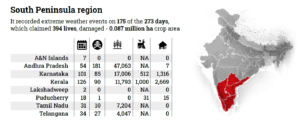
According to the report, Kerala witnessed extreme weather as follows. 2022: 55 days and 96 deaths; 2023: 67 days and 74 deaths; 2024: 113 days and 552 deaths; 2025: 147 days and 114 deaths; 2026 (January – September): 126 days and 90 deaths.
Of the seven types of extreme weather events analyzed, India experienced six between January and September 2026— all except cyclones.
The 2026 winter season recorded the second-lowest number of cold wave and cold day events in the past five years. For the first time in five years, February 2026 witnessed no cold wave or cold day events, reflecting the unusually warm conditions during the month. February was also the fourth-warmest in 125 years, highlighting the link between the absence of cold wave events and the exceptionally high temperatures recorded. During the pre-monsoon season (March–May), lightning and storms were the most frequent extreme weather events. Hailstorms, a major part of these events, occurred on 80 per cent of the days in April and May 2026, affecting 27 states and causing
significant crop damage. In 2026, India’s southwest monsoon ended with 13 per cent less rainfall than the long-period average.
However, this did not mean fewer extreme weather events. Heavy rain, floods and landslides occurred somewhere in the country on all 122 days of the monsoon season, damaging at least 3.44 million hectares of cropped land. With El Niño strengthening
and drought conditions affecting more than half of India, including regions facing extreme and exceptional drought, the year has been devastating for farmers.
Down To Earth managing editor Richard Mahapatra – the man behind this report — says: “What the country has witnessed so far is really the new normal in a warming world. Our report is an attempt to build an evidence base on the frequency and expanding geography of extreme weather events in India. Publicly available current data on such events is fragmented and fails to provide the complete picture – this report attempts to correct this anomaly.” He adds: “The report’s findings also signal a crucial shift needed in India’s approach: from disaster response to risk reduction and resilience building. Flood management, for instance, requires more than contingency plans — it demands robust drainage and water-recharge infrastructure, along with restoration of green spaces and forests that can act as natural water buffers in future storms.”
Five-year trends: What the report says
· Share of affected days rose from 86-88 per cent in 2022 and 2023 to 93 per cent in 2024 and 99 per cent in 2025; 2024 was the hottest year on record. In 2026, India had an extreme weather event breaking in one or more parts of the country for almost 92 per cent of the first nine months.
· Deaths and devastation: Extreme weather claimed 16,303 lives across the country over these five years — nearly 65 per cent of these deaths occurred between 2024 and 2026. Annual deaths rose from 2,755 in 2022 to a five-year high of 4,064 in 2025. In 2026, the toll stood at 3,320, 21 per cent higher than in 2022.
· The damage to agriculture has increased. At least 20.6 mha of cropped land have been affected between 2022 and 2026, with over 82 per cent of the damage occurring in the last three years. From 1.84 mha in 2022, the affected area had jumped up to 9.47 mha in 2025. In 2026, another 4.25 mha were affected, the second highest figure in five years. Says Kiran Pandey, programme director, environmental resources, CSE and the lead writer of the report: “As the El Niño strengthens in the tropical Pacific and drought conditions persist in more than half of India, the first nine months of 2026 have been devastating for farmers, who continue to commit suicide at the rate of one every hour.”
· Country-wide phenomena: The rise in extreme weather has been seen across all regions. In central India, the share of days affected by extreme weather rose from 73 per cent in 2022 to 78 per cent in 2026; in east and northeast, from 63 to 80 per cent; in the northwest, from 71 per cent in 2022 to 94 per cent in 2025, before falling to 86 per cent in 2026. In the south peninsular region, the share increased from 46 per cent in 2022 to 75 per cent in 2025, before declining to 64 per cent in 2026. Says Pandey: “While the intensity and type of events vary across seasons and regions, no part of the country has remained untouched.”
· Changes in seasonal weather patterns : Winters have become warmer, with fewer cold wave events. The 2026 winter recorded the second-lowest number of cold wave and cold day events in five years – February, in fact, saw no such events for the first time in five years and was the fourth-warmest February in 125 years. Heatwaves appeared early, with Himachal Pradesh and coastal Andhra Pradesh recording episodes.
· Monsoons: The pre-monsoon period emerged as a period of heightened risk for agriculture. Between March and May 2026, at least 0.73 mha of cropped land was affected — the second highest loss recorded during this season in the past five years, after 2023. In 2026, the southwest monsoon ended with 13 per cent less rainfall than the long-period average – but this did not mean there were fewer extreme weather events. Heavy rain, floods and landslides occurred somewhere in the country on all 122 days of the monsoon season.
Speaking at the webinar, Narain said: “The trends show that every year, we have witnessed almost one extreme weather event every day. Each year, we are battered, and left with no time or energy to even recover and find our feet before the next event happens. Each year, the spread has increased, and today, almost every part of the country is reeling from the onslaught. Governments are aware of this, they do not need to be told that this is happening – they know. What we are aiming to do through this report is to put this picture together for governments and tell them that this is not just about one region, one day, or one state – this is a pan-India issue which we have to tackle.”